Sunday, 27 October 2013

Morrissey, Autobiography: The Music


Here are all of the name-dropped songs and singles that furnish Morrissey’s Autobiography (excluding his own, of course) compiled as a playlist with all that Spotify will allow. Warning: it’s (predictably) quite brilliant…Here is the Spotify link: Morrissey: Autobiography playlist and the track listing is below. Treat yourself to my review of the Autobiography here

Track listing:


Millie – My Boy Lollipop
Roy Orbison – It's Over
Manfred Mann – Pretty Flamingo
New Vaudeville Band – Peek A Boo
Four Tops – Bernadette
Paul Jones – I've Been A Bad Bad Boy
Francoise Hardy – All Over The World - English Version of "Dans Le Monde Entier"
The Righteous Brothers – You've Lost That Lovin' Feelin' - Single Version
Jimmy Jones – Good Timin'
Tony Orlando – Bless You
Marianne Faithfull – Come And Stay With Me
Love Affair – Rainbow Valley
The Foundations – Back On My Feet Again
Small Faces – Lazy Sunday
Sandie Shaw – You've Not Changed
Lulu – I'm a Tiger
Rita Pavone – Heart
Diana Ross & The Supremes – Reflections - Single Version
Diana Ross & The Supremes – I'm Livin' In Shame - Juke Box Single Version (Stereo)
Matt Monro – We're Gonna Change The World - 2010 Digital Remaster
Shirley Bassey – Let Me Sing and I'm Happy
Paper Dolls – Something Here In My Heart
David Bowie – Starman - 2002 Digital Remaster
Buffy Sainte-Marie – Soldier Blue
Buffy Sainte-Marie – Moratorium
The Pioneers – Let Your Yeah Be Yeah
Dave And Ansel Collins – Double Barrel
Bob & Marcia – Young, Gifted And Black
Springwater – I Will Return
Hurricane Smith – Don't Let It Die
Jo Jo Gunne – Run Run Run
The Elgins – Heaven Must Have Sent You
T. Rex – Jeepster
T. Rex – Metal Guru
T. Rex – Telegram Sam
Mr Bloe – Groovin' With Mr Bloe
Blue Mink – Melting Pot
Roxy Music – Virginia Plain
New York Dolls – Jet Boy
New York Dolls – Trash
Mott The Hoople – All The Young Dudes
Faron Young – It's Four In The Morning
Melanie Safka – I Don't Eat Animals
Iggy & The Stooges – Your Pretty Face Is Going To Hell - Iggy Pop Mix
Sex Pistols – Anarchy In The UK
Sparks – This Town Ain't Big Enough For The Both Of Us
New York Dolls – Frankenstein
New York Dolls – Personality Crisis
Nancy Sinatra – Happy
Dionne Warwick – Loneliness Remembers What Happiness Forget
Jobriath – Morning Star Ship
Pony Club – Single
Ewan MacColl – Morrissey and the Russian Sailor
Kirsty MacColl – You Know It's You
Nancy Sinatra – Let Me Kiss You
Patti Smith Group – Because the Night
Brigitte Bardot – Bubble Gum
Herman's Hermits – East West 
David Bowie – Drive In Saturday - 1999 Digital Remaster


Wednesday, 16 October 2013

People: a play by Alan Bennett, National Theatre on tour, The Lowry, Salford, 15.10.13


Lady Dorothy Stacpoole (Siân Phillips), former model and socialite, is approaching her dotage and sitting on a fortune in the shape of a crumbling family home stuffed to the gills with antiques. It’s just the kind of stately pile the National Trust would love to get their hands on, and that’s just what Dorothy’s sister June, an Archdeacon, has in mind. Horrified at the prospect of people swarming about the place, Dorothy is persuaded to consider a rival offer from a mysterious wealthy sect who promise to pay over the odds and keep the house mercifully free of people. After all, ‘People spoil things...’

History is once again Alan Bennett’s theme, specifically our attempts at preserving heritage. Oddly enough, it only becomes apparent that the play is actually a farce in the second half of the production, round about the time you notice the stage is peopled with two porn actors, a camp bearded Welshman and a bishop. Nobody actually mounts the stage with a toilet brush at any point, but subtlety takes a back seat during Bennett’s medium-to-heavy roasting of The National Trust and the Church of England, whose membership ‘is virtually the same’.

Dorothy nobly resists becoming ‘a metaphor for England itself’, though the play doesn’t do much to help, variously accessorising her with British hits of the ‘60s, Henry VIII’s rosary, and a collection of chamber pots containing original deposits from the likes of Kipling and Elgar. Iris (long-time companion but actually half-sister to Dorothy, played beautifully, if quietly, by Brigit Forsyth) punctuates proceedings with some glib relief, delivering a mix of blunt truth and endearing misunderstanding.

Overall though, the too-varied plot threads and dramatic motifs, and some oddly mismatched characters, drag on the play’s momentum, but the set is a character in itself, majestic and ramshackle, there are witty one-liners aplenty, and Dorothy is a gem – sad, but not sentimental, rugged and forward-facing, even against the odds – in fact, terribly English, you might say, and certainly worth preserving.


Saturday, 7 September 2013

‘Manchester: In Residents’ … #26 Hayley

‘I'd open all of the closed doors of the city…’


What’s your name?

Hayley Flynn


What do you do?

I used to work in finance, then advertising, then I realised I couldn't do any of those things for the rest of my twenties, much less the rest of my life so I quit and started to write about the unusual architecture and history of Manchester. And so my blog Skyliner was created, and now I do everything else that goes hand in hand with that; researcher, curator, location scout, and I've just signed a book deal too.


Where do you live?

Whalley Range, on that kind of periphery some people like to call the ‘Chorlton Border’. The house I'm living in right now is owned by a dentist so we have a dentist chair in the dining room, and from the bathroom window I can see the beautiful old college (now the British Muslim Heritage Centre) poking out amongst the tree tops.  I still can't believe such a behemoth of a building exists in the suburbs – I like to pretend I'm living in the shadows of a castle.


Tell us the story of how you ended up in Manchester.

As a child I was very studious and loved to learn, I never lost that love of learning but I rebelled against the enforced structure of school and I guess I went a little off the rails and did pretty poorly in my exams. All my choices from then on were a reaction to that; I chose a college course that seemed the most likely to end in a sensible job but which ultimately I hated – I failed to turn up nine times out of ten and I was kicked off the course a few months before the end. I lied about that then landed an office job but I could never shake the nagging thought of ‘you have to do this for the rest of your life’. When my dad died when I was nineteen I used the little inheritance I had to go to Australia for a year. Manchester was just the first place I secured a temping job on my return. Nothing clicked when I got here; my work still made me unhappy and I was in a bad relationship but those things prompted me to go back to college in the evenings and do a course that stimulated me, not one that had the promise of a job at the end of it – and what do you know, I got full marks on almost every exam. That was when I realised I had to do what made me happy or I'd fail, and that's when I became a kind of student of the city. You have to live like a tourist in your own home or it's wasted on you.


What’s great about this city?

It's tiny so you take the time to appreciate every part of it, the suburbs as well as the city. I love how the Salford border lies just behind Deansgate, there's something quite alluring about the River Irwell and that side of the city. Parsonage Gardens is an oasis and it's really what St Peter's Square (a conservation area) should be like – timeless, peaceful, and surrounded by stunning architecture. I love the stillness and almost dystopian feel of Pomona. I'm generally enamoured by wasteland spaces and the alternative countrysides of a city.


What’s not so great?

It's being bulldozed into oblivion – the council do not value our heritage. Century House is being demolished because the windows are too small… ummm, I beg your pardon? Surely making them bigger is the better option but instead they're going to demolish the entire building to replace it with an Ian Simpson greenhouse. Compare our skyline to that of Liverpool. Which one would you proudly show off to a visitor to the UK? This is going to be a very sad-looking city a generation from now.

The divisions of the city baffle me, the way people stay in the same part of town. I'm trying to open people’s eyes to the beauty outside of the Northern Quarter. I think the spread of a few new bars to the Peter Street area of town will help. I love the roof and the intricacies of Barton Arcade, and yet it's little more than a ghost arcade, it should be our version of Leeds' Victoria Quarter. Something is amiss when we can't put a location as pretty and as central as that to good use.


Do you have a favourite Manchester building?

I'm far too capricious to have just one, so to choose at random I'd say the former Refuge Assurance Building (now the Palace Hotel). The building is decorated with lots of symbols of refuge such as castles and boats, but it's the maze-like interior that enraptures me. You can walk around in there all day and never see the same room twice – that’s something you don't really get in modern buildings, and even the hotel owners didn't know there was an orchestra pit in the basement when they bought it. There's a tiny roof terrace that I like to go and sit on at dusk and watch the bats circle the clock tower. There's a room you can cut through to get to the bedrooms that's full of old wooden safes, and once upon a time the building had a series of pneumatic tubes used for delivering messages. It's wonderful. It's my favourite place to waste an hour or two.


Do you have a favourite Mancunian?

I'd like to cheat a little here and name my favourite type of Mancunian and that is a building concierge who loves their building. There's nothing better. They're excited to share what they know and love with a new audience, they lie dormant waiting for someone to say, ‘Show me around, tell me what you know!’, and then they spark into life as tour guides. They're a rare breed, you're more likely to find the other kind, the ones that eye you with suspicion for even showing an interest and scornfully shoo you away, but they are out there and they won't work forever so go and find them, question them, and record what they tell you!


What’s your favourite pub/bar/club/restaurant/park/venue?

I've been waiting a long time for the Lower Turks Head to reopen and they've done a lovely job so that's a current favourite, and The Cornerhouse is very special to me (I hope the stories I hear of it being demolished when they relocate aren't true).


What do you think is missing from Manchester?

I've always thought it was odd how Chorlton doesn't have a little independent cinema, that's my lottery winning plan, to set one up. There needs to be a film academy for teenagers, more internet cafes, hostels and places for a younger tourist market. We focus on football tourism too heavily. I'd like a little more life bringing to Ancoats too. Of course, we need a council that doesn't want to flatten the city first, but I suspect I'll be wishing for that for a long time to come.


If I was Mayor for a day I would …

… fire a lot of people in charge of Manchester heritage and then I'd visit artist studios around the city and nominate their residents to take care of the city's planning department. Then I'd open all of the closed doors of the city.


Who else would you like to nominate to answer this questionnaire?

Paul Costello, the lifelong concierge of the Mercure Hotel.


Hayley runs semi-regular tours looking at street art, hidden art, unusual features of the city and secret locations, including tours of the Godlee Observatory for Manchester Science Festival. New and exciting locations and tours are coming soon. Hayley is forever on the lookout for new collaborations with photographers, artists, writers, and anyone with interesting stories and information about Manchester. Check out her award-winning Skyliner blog.


Wednesday, 4 September 2013

Tuscany

Tuscany... even the word is a kind of dreamy homophone for ‘dusk and honey’ – and honey is near enough a decent simile for the light too. There’s something about the way the sun meets the earth there that lets you see ‘the shape of the day', as our wonderful host Claudia put it. But the light… it's the light that my Aunt had told me she couldn’t describe, and here I am, not describing it for her…

But first, Rome…


On my previous trip to Rome, the tour guide delighted in telling us that we’d arrived on the rainiest weekend for fifty years.  Everything was sticky and grey, and even the Trevi Fountain couldn’t make itself heard above the torrent. There was a certain romance watching rain douse the sides of the Colosseum but mostly it was a false start for me and Rome.


This time though, the sun is out, and twenty four hours of hot Roman holiday await. Katie and Eddie meet me off the train, already looking like accomplished locals, all shiny and brunette. We are borrowing a beautiful apartment for the night which is stuffed with Proust in Italian translation and shelves of orchestral vinyl. Our street is just by the Michelangelo-designed Porta Pia, a sixteenth-century gate in the city walls that was commissioned by Pius IV. It is a very important gate in Rome because it leads you to the street where you encounter the best ice cream of your life. For me this was mascarpone and latte in one scoop, pistachio in the other, a topping of freshly whipped and sweetened cream that tasted of nougat, and all presented in a crisp, waffle-textured cone that was filled to halfway with warm, melted dark chocolate.


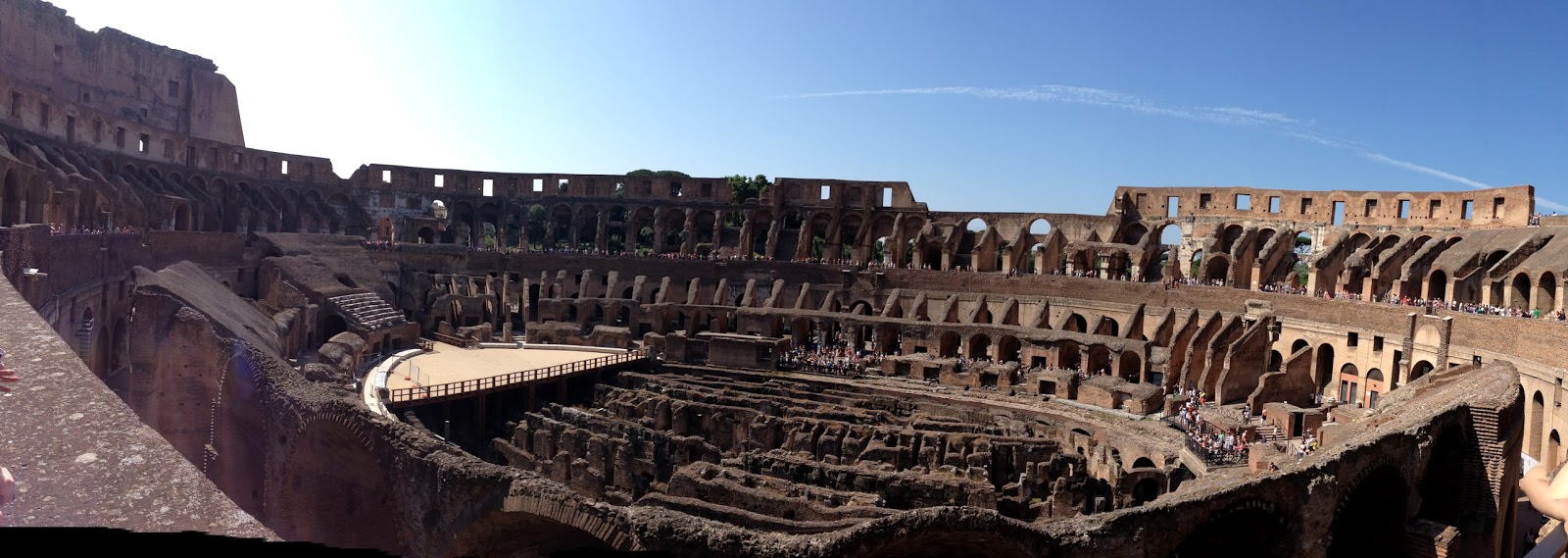
The Trevi at dusk works its magic this time, though the mass of people make it feel like the entrance to a particularly lovely stop on the Metropolitana. Al fresco pizza, red wine and an early night. We’re up bright and early to beat the crowds to the Colosseum. You have to imagine the roar of the throng as you walk through the stone entrance. Inside is both partially constructed and pleasingly derelict. The audio guide is a good way to go about things, especially if you’re adept at reading between the lines…


The history of the Colosseum is also the story of the Empire itself. Current affairs were acted out in the amphitheatre like dramatised newscasts. When a whale beached up on the coast, a wooden whale was hastily built to be paraded around the stage. Before the astonished crowds it opened its mouth and out tumbled dozens of live bears. The subsequent fortunes of the Colosseum mirrored the changing Rome and all manner of bloodshed and worship, theatrics and morality plays,  squatters and gay cruisers (not on the audio guide), found a home inside its walls over the centuries. Preservation and audio guides seem a tame future in comparison.


On the train to Arezzo I start reading A Room With A View. It’s my first (and so far only) Forster, downloaded in a hurry to the Kindle, but it could not have been better chosen. Almost immediately the sensation of being in this part of Italy is there on the page (or rather, on the screen). From the station we drive through lush country and into the hills that border Tuscany and the oddly English-sounding Umbria. The first view of the house is a thrill and I’m already drafting some or other novel about an impossibly spoiled girl and her Italian summer of self-discovery.

In the morning I open the shutters to a fug of lavender and a little hornet bouncing off the window. His buzz gives way to a guitar being tuned somewhere which mingles with the hum of farm machinery from across the valley. Everything is like this – musical and hypnotic. It’s hard to remember ever being tetchy and cross back home. I am very lucky to be here.


Forster fever peaks on a day trip to Florence. We pass the ‘View’ of the title and the probable location of the pensione. I have already learned that our hosts and friends once stayed in the room in Paris where Forster worked on the novel.  Not only that but they are also a family from Tunbridge Wells, as in the novel, though infinitely less prickly of course. The tourists move in packs of forty and fifty through Florence, it is a difficult town to negotiate, but there is more ice cream and coffee to be had, and all the greatest Italians are in the ground somewhere and in the atmosphere.


On my morning run next day I meet a deer that rattles its antlers on the tree when it sees me. When I dive into the pool back at the house to cool off, there is a tiny frog doing lengths. I write the first draft of this piece on the terrace at the back of the house, looking down past the swimming pool and over the fields to the town of Montherci. There is a very precise little lizard poised inside my discarded sandal and the cicada that lives in the tree above has started its mechanical chirrup for the evening. When it goes dark we can see a firefly in the foliage, lonesome and hovering. It is the same colour as Venus, the brightest thing in the sky.

Friday, 30 August 2013

Pride: afterthoughts


I thought this year I’d wait until the dust settled. It seems it’s very important in Manchester to have an opinion about the annual Gay Pride festival, or at least to tell everyone about it on Facebook. If you run a gay night or two, like I do, some people want to perceive you as some kind of spokesperson. I’m not, but I was needled several times to say something scandalous in the direction of Manchester Pride. I don’t have it in me. I think it boils down to this: Pride as a party, or Pride as a protest/political consciousness raiser? Doing both isn’t really working. At least not for me.

Don’t get me wrong, we need big gay cultural happenings, and we have them: Homotopia, Queer Up North, Duckie at Southbank, Queer Contact... These sorts of events are by and for LGBT people and have been brilliant over the years. Go and find out. Buy tickets. Support them. But spending bundles of pink pounds to hire The Feeling and a reformed Sugababes under a banner of ‘Gay Pride’? How exactly does it ‘celebrate LGBT life’?  I’m not sure I get it. Or want it. If you must attend a Kate Nash concert, just go to one, like everyone else does. I go to gigs all year round, I don’t need Pride for that. I need Pride for something else.

We might be about to get marriage equality in the UK, but worldwide the net is closing in on gay people. It’s real and I am frightened by it. If you don’t have a global perspective about yourself as a gay person, the concept of perceiving yourself as a group at all – which is, after all, the essence of Pride –falters. Except that Pride itself isn’t the place to talk about this, and I wonder if it should be. I am pleased that Manchester Pride expanded its Fringe program to include smaller arts and cultural events, including, crucially, some that take place outside the ghetto. I am glad the Pride Board has a trans* individual on it. I am glad they erected a ‘To Russia With Love’ wall in the Village to show Mancunian’s support towards persecuted people in our twinned city of St Petersburg. I hope they leave it up beyond Pride, I’d like to see it myself. But why Russia now, and not Uganda any other year, or any one of the dozens of ex British colonies where we exported homophobia to in the first place, at any other Pride? It’s complicated, and I’m trying to dance here.

During Manchester Pride, only a paid wristband gets you access onto Canal Street, unless you live there, and even bar staff who work in the Village can’t see the big bands without paying. I put parties on for gay (and non-gay) people outside the Gay Village. I do it all year round and I do it over Pride too. You might think this is somehow divisive, luring punters away from the gay enclave. But sexuality has no postcode, and the Village itself has barely any club space anyway, while the bars during Pride weekend – it has to be said – are overcrowded, overpriced, riddled with bad beer and bad music. I moved away from Blackpool a long time ago to get away from that. It’s not for me.

This year, I’m part of a newly-formed and loose collective of promoters under the name Queer Alt. Manchester who hosted a roster of alternative and non-Village gay and queer events during Pride. If you think we’re cashing in; yes, we absolutely are. Every last one of us donated cash to charities, and paid our performers. As for Pride itself, I’m not sitting in judgement, it would be the height of hypocrisy. It was only a few years ago I went out on the Thursday of Pride, and with very few breaks, kept going one way or another until the Monday. Trust me, I wasn’t thinking about St Petersburg then.

Besides, I’m not sure what form a more politicised Pride would take anyway. For the most part I’m an armchair activist. The odd demonstration aside, I’m all about petitions, letters, angry Tweets, political discussions, charity donations, that kind of thing. Are you much different? But I would like another way to get to meet the community sometimes, one that didn’t involve booze. Especially now, when I feel so powerless to contribute to any kind of positive change in the world. I feel hopeless when I think about Uganda or Moscow, never mind Damascus or Cairo or Palestine. But this has happened to me before, and the way I got out of it? Reading Angela Davis and listening to Larry Kramer. Watching REDS. Reading about mass resistance and small victories. Watching TED lectures about community action and feminism. Watching ACT-UP videos on YouTube. Watching We Were Here. This is where something like Gay Pride should come in, to bolster that feeling of insurmountable human aggression and oppression, to tackle the apathy that inevitably follows. Watching Barclays Bank drive a truck down Deansgate decked out in this year’s designated Pride theme (‘The 1980s’) was never going to do that for me. And I really need it.

Wednesday, 21 August 2013

‘Manchester: In Residents’ … #25 Rachel


‘I’ve lived all over – Glasgow, Leeds, Sheffield, Sydney – but always come back to Manchester. Well, we do, don’t we?’


What’s your name?

Rachel Broady


What do you do?

I’m a qualified journalist and university tutor but, sadly, I’m currently ‘between jobs’. Any offers gratefully received. Just nothing where I have to add up; like many journalists I’m useless at maths.


Where do you live?

A lovely, little housing association flat in Levenshulme, south Manchester. As tatty as the A6 is, I’m not sure there’s another part of Manchester I’d ever choose to live in. I’m listening to the police helicopter overhead as I type. How romantic!


Tell us the story of how you ended up in Manchester.

I was born in Droylsden, moved to London as a child then returned with a very strong Cockney accent. Growing up in Newton Heath, being bullied at school and listening to The Smiths, made sure I was soon back talking properly. I’ve since lived all over – Glasgow, Leeds, Sheffield, Sydney – but always come back to Manchester. Well, we do, don’t we?


What’s great about this city?

It’s home; it really is. I think whether you were born here, or you’re a ‘woolly back’ from Droylsden, or you’ve arrived from wherever, Manchester will end up feeling like home and has done to people for decades, centuries. It also has a political history to be proud of, writers to admire and buildings that still take my breath away (I mean the Town Hall, not Beetham Tower!).


What’s not so great?

The poverty; Manchester has some of the most deprived areas in the country. Its children are some of the poorest. Manchester Central has the highest percentage of children living below the poverty line in the UK; some 47% living in poverty. Wood Street Mission in the city centre has seen a big increase in the number of families needing basics like school uniforms. It’s a national problem but Manchester’s ‘glitterati’, the so-called regeneration, with expensive, exclusive apartment blocks, and the sometimes homogeneous feel of the city makes the division of rich and poor all the more real. As a city we should be appalled by this!


Do you have a favourite Manchester building?

I still love the Town Hall. I know it was built rather than clear away slums; I know that decision was expensive, arrogant and boastful but, blimey, it’s beautiful inside. I also like Urbis and I’m fond of some of the 60s architecture that others hate; Piccadilly Plaza has a place in my heart. I find a lot of the ‘regeneration’ buildings ugly: the Chips building, for example. I just think such blocks are soulless, community-sapping monstrosities. I really don’t like Beetham Tower, either; I don’t care if it whistles, it looks like Lego.


Piccadilly Plaza

Do you have a favourite Mancunian?

Obviously any Manchester socialist would have to say Mary Burns who gave Engels the chance to see first hand what it was like for the Irish living in Manchester in the mid-1800s. Ok, I know she was Irish. In fact, she lived in Salford not Manchester. Oh, I’m claiming her as ours for the purposes of name-dropping! And, in no way connected at all, Les Dawson. I have a real soft spot for Collyhurst-born Les Dawson. Many will reel, thinking of his mother-in-law jokes, but you have to remember the way young couples were forced to live with their mothers-in-law back then, and humour would be a way to cope! I’m also growing increasingly fond of Terry Christian who seems a wise, tolerant and interesting auld fella.


What’s your favourite pub/bar/club/restaurant/park/venue?

I like the Cornerhouse. I remember being taken there on a school trip when it first opened and I think it’s still a comfy place to sit and get quietly drunk, while discussing books and that. I also like Rusholme and would take any visitor there for a decent, cheap curry. Oh, and I love Lounge Ten. I was born for its style and decadence but can rarely afford to go; if anyone wants to take me …


What do you think is missing from Manchester?

I think Manchester has to remember and celebrate its radical political history. The Peterloo Massacre memorial will go some way to achieving that but the co-operative movement, the trade union movement, the suffragette movement – all these Manchester firsts should be an obvious, celebrated, recognised, constant part of our city’s heritage.


If I was Mayor for a day I would …

I wouldn’t. I think it’s a silly role.


Who else would you like to nominate to answer this questionnaire?

James Draper


Rachel recommends Red Flag Walks and Radical Manchester for learning about Manchester’s radical heritage.